Signature Style for My Name in English: 21 Ideas
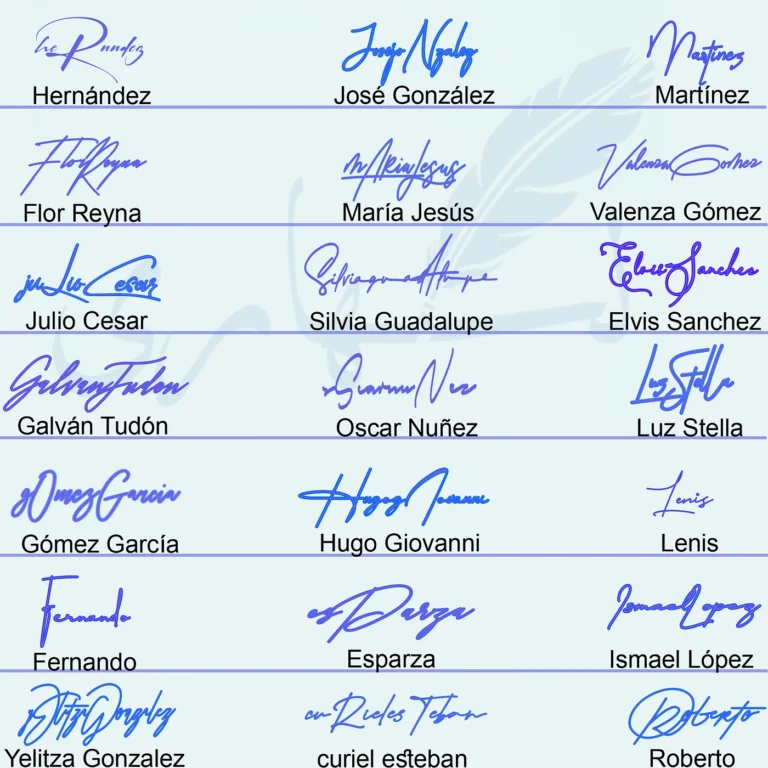
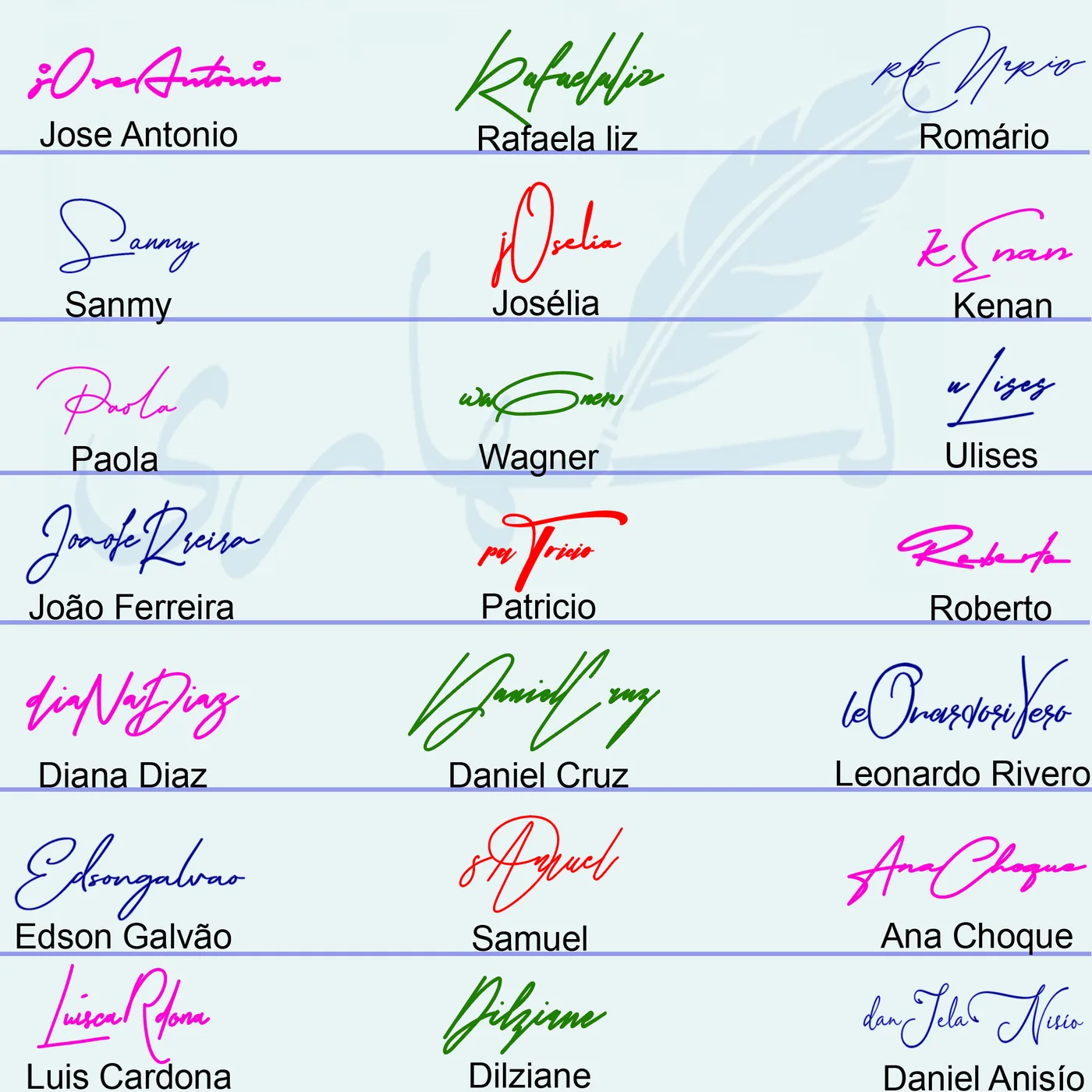
To choose a signature style for your name in English, first decide whether you want a readable full name, a large initial with a compact body, two visible capitals, or a short abstract mark. The 21 examples below use names written with the English or Latin alphabet and show how those structures change across short, long and two-word names.
People often search for an “English signature” when they mean a name written in Roman or Latin letters rather than another writing system. The name itself may be English, Spanish, Portuguese or from another language. What matters here is the letter structure and how naturally those letters connect.
In this gallery
- Compare the 21 English-letter styles
- Choose by name pattern
- Create the style online
- Check the final design
Signature styles shown in the 21 examples
Readable single-name styles
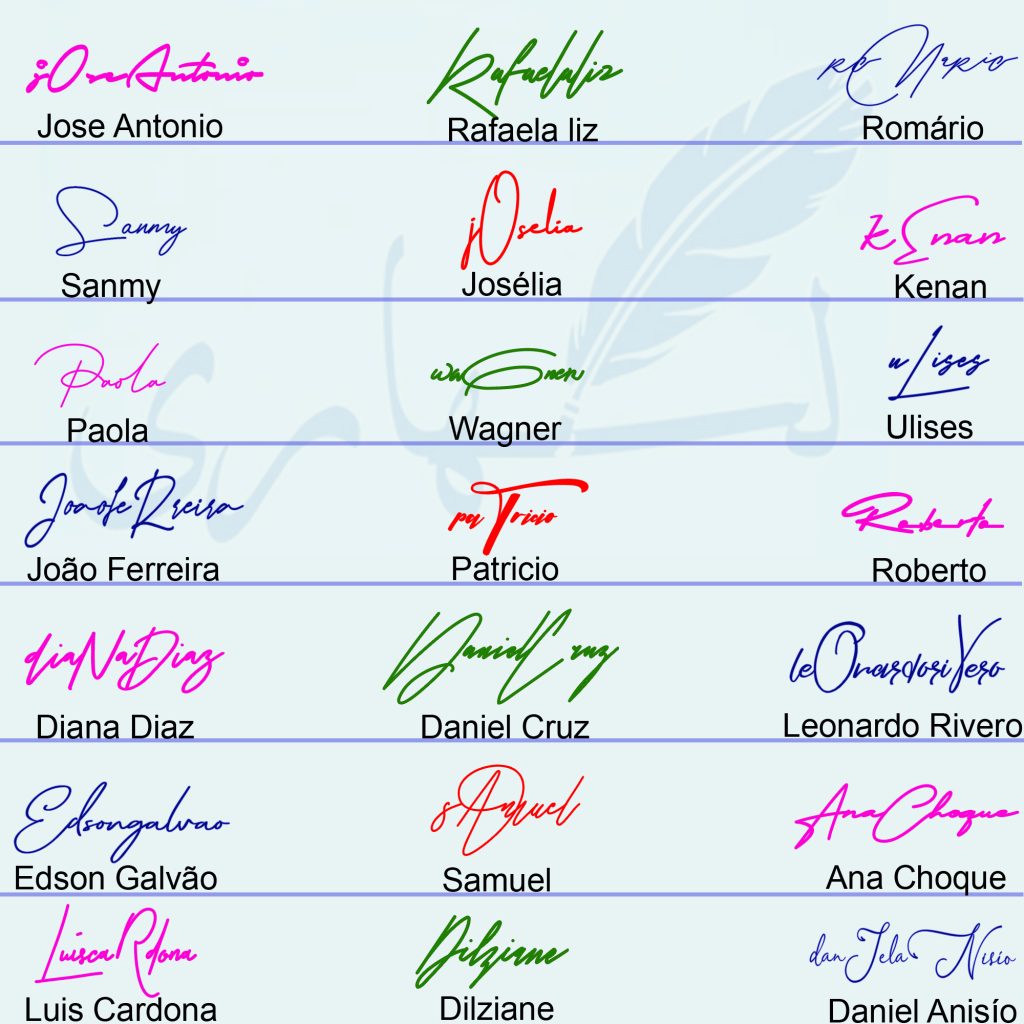
Sammy, Josélia, Paola, Roberto, Samuel and Dilziane keep several letters visible. Sammy uses a large open S and a clean baseline; Paola uses a simple rounded P; Samuel gives the first capital most of the detail and lets the rest move quickly. These are useful directions when you want the name to remain recognizable.
Large-initial styles with a shortened body
Rafaela Liz, Romário, Wagner, Patricio and Ulises rely on one dominant initial or central stroke. Rafaela Liz uses a tall angular beginning, Wagner compresses the name around a broad oval movement, and Ulises adds a direct underline from the final stroke. This format works well when the full name feels too long.
Two-word full-name styles
Jose Antonio, João Ferreira, Diana Diaz, Daniel Cruz, Leonardo Rivero, Edson Galvão, Ana Choque, Luis Cardona and Daniel Anísio show several ways to handle two parts. Some display both capitals clearly; others create one continuous line and reduce the surname. The best choice depends on whether readability or signing speed matters more.
Compact abstract styles
Kenan, Wagner, Patricio and Roberto reduce the internal letters strongly. These examples can inspire a short mark, but a compact design should still have a stable first movement, width and ending. Random scribbling is not the same as deliberate simplification.
Choose a style for your English-letter name
| Your name pattern | Useful examples | Recommended structure |
|---|---|---|
| Short one-word name | Sammy, Paola, Samuel | Large initial plus readable connected letters |
| Long one-word name | Dilziane or Josélia | Emphasize the capital and compress repeated middle strokes |
| Two short names | Diana Diaz or Daniel Cruz | Show both capitals with a short transition |
| Two long names | Leonardo Rivero or Daniel Anísio | Use one dominant capital and a reduced surname movement |
| Need a quick compact mark | Wagner, Patricio or Roberto | Keep a stable initial-led silhouette and simple finish |
Letter shape also matters. Tall letters such as L, T, H and K can become entry strokes or vertical anchors. Round letters such as O, C, G and Q can form loops. Letters with long descenders or tails can become underlines. Choose a feature that already belongs to your name instead of attaching an unrelated decoration.
For a complete comparison of cursive, minimalist, initials, full-name and underlined options, use the different signature styles guide. The handwriting signature examples focus more closely on natural movement and repeatability.
How to create your name signature online
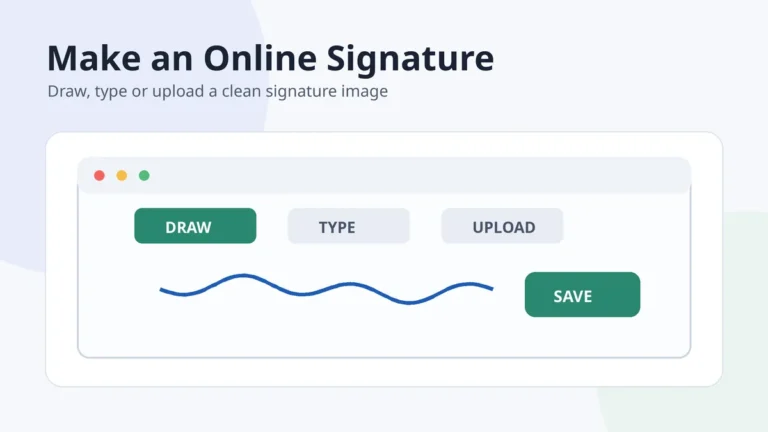
- Shortlist two structures from the gallery. Pick one readable version and one compact version.
- Write both by hand first. This reveals which connections are natural before a tool smooths or stylizes the result.
- Use type mode only for exploration. Compare broad script shapes, but do not assume a font is automatically your finished signature.
- Use draw mode for personal movement. A phone, tablet or stylus is usually easier than a mouse for curved strokes.
- Upload a paper version when you already have a stable signature. Crop it closely and remove the background.
- Download a transparent PNG. Keep the proportions unchanged and store the clean master file privately.
Check the design before you keep it
- Opening letter: the main capital should remain recognizable at normal signature size.
- Name hierarchy: two-word names should have a clear relationship between first name and surname.
- Accents and marks: if an accent is part of the form you want to use, place it consistently rather than randomly.
- Repeatability: width, slant, crossing points and ending should remain reasonably stable over five attempts.
- Digital image quality: the exported file should have clean edges, correct proportions and no unwanted white box.
An online tool can help you draw, compare and export the result, but the strongest style still begins with your own name structure. The tool should make the design usable, not choose every letter on your behalf.
Frequently asked questions
What does “signature style for my name in English” mean?
It usually means a signature written with Roman or Latin letters. The person’s name can come from any language; the focus is the alphabet and letter connections used in the design.
Should I type or draw my name online?
Type to explore broad styles quickly. Draw when you want a more personal movement. Upload a paper signature when you already have a version you use comfortably.
Which style is best for a long English name?
A large first initial plus a compact surname, or two capitals with shortened middle letters, usually controls width better than writing every letter with equal detail.
Can I keep accents in my signature?
Yes, if you want them as part of the written form. Make their placement consistent and ensure they do not interrupt the natural signing movement.
What format should I download?
A transparent PNG is flexible for placing a signature image on different backgrounds. Keep a high-quality private master and use resized copies where needed.
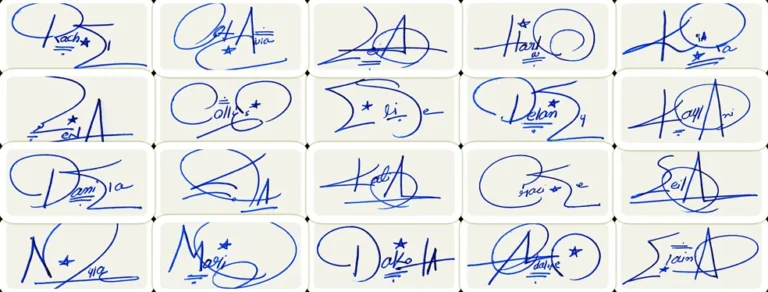
Single Signature Examples from This Collection
These individual handwritten signature images are included as supporting examples so visitors can compare one name at a time. Each caption preserves the name reference and makes it easier to study initials, loops, finishing strokes and overall signature flow.