Signature in Handwriting: 21 Name Examples
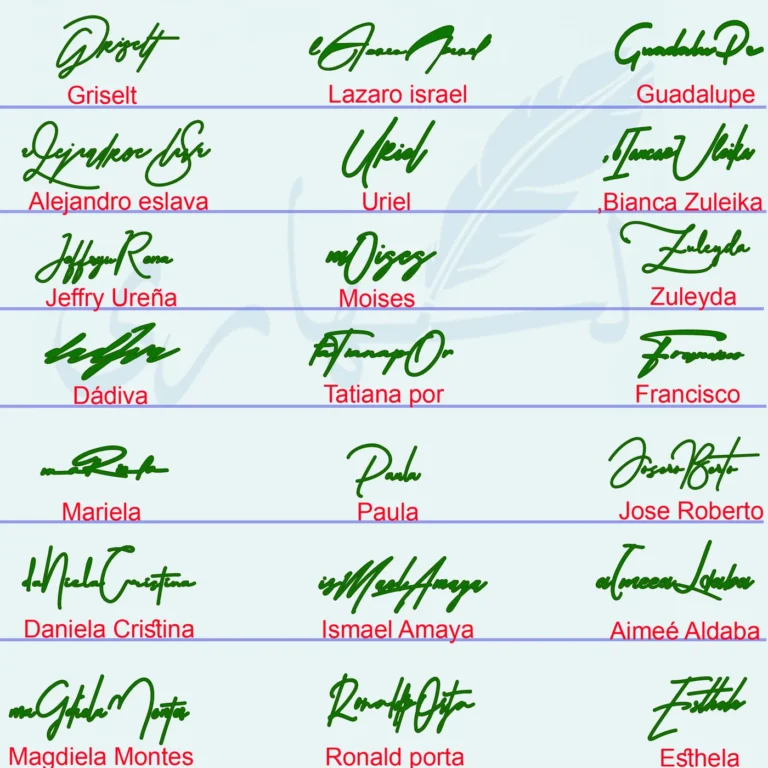
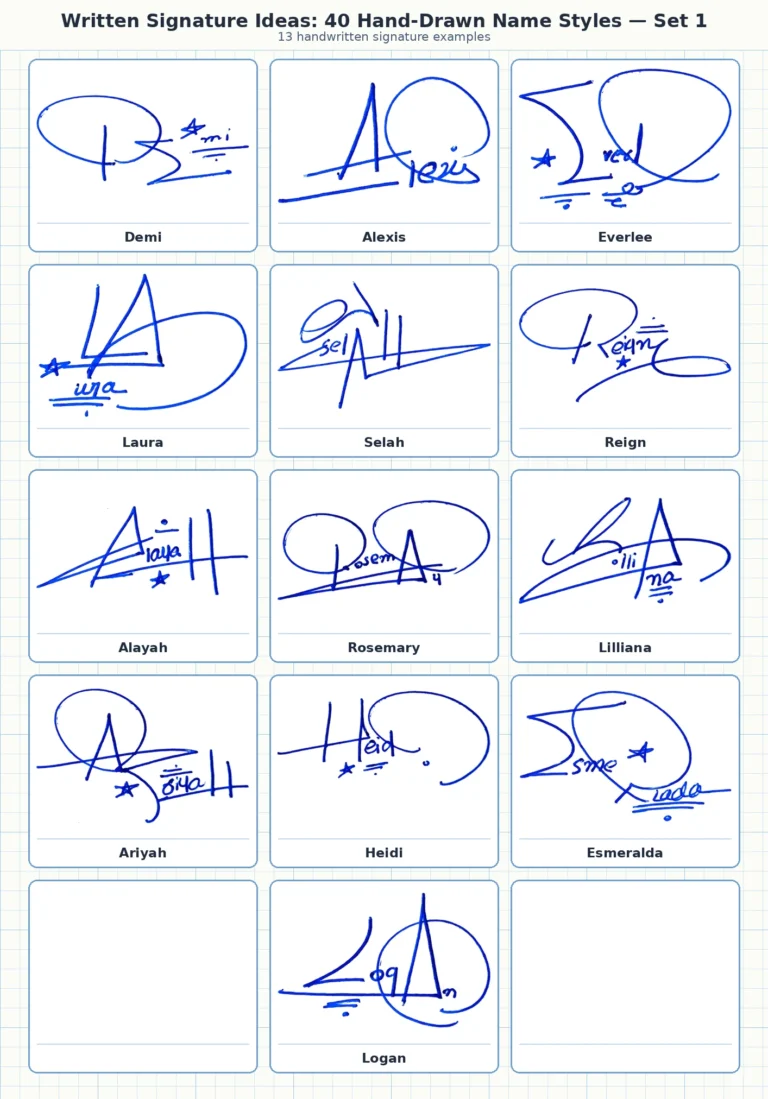
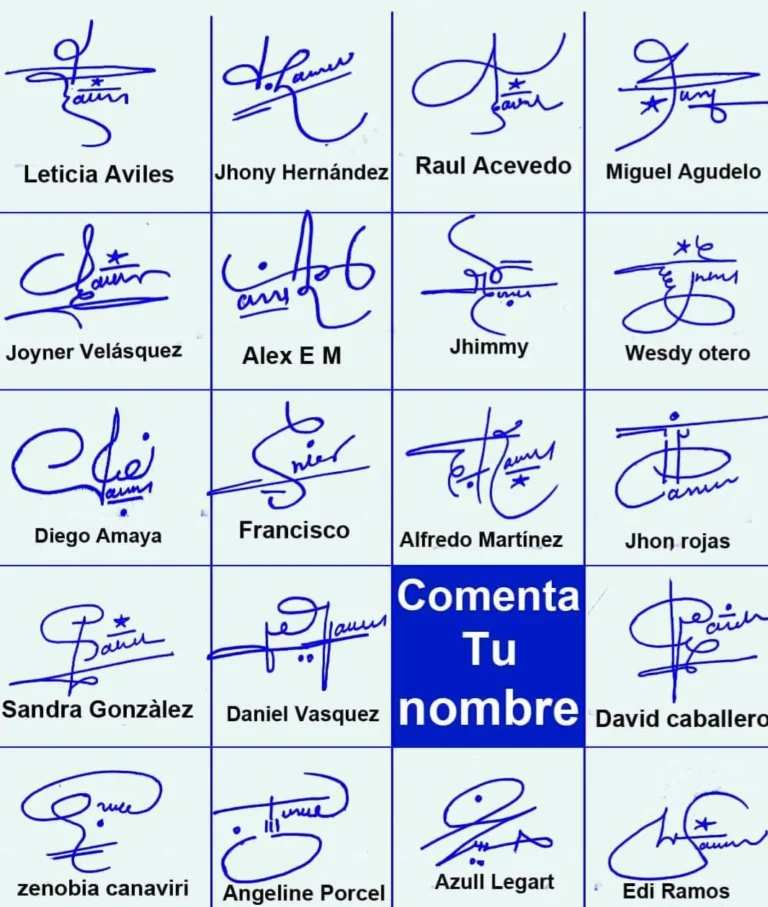
A signature in handwriting should feel like one controlled movement rather than a name that has been carefully drawn letter by letter. The 21 examples below show how real name structures can be shortened, connected and emphasized with large initials, compact lowercase strokes, loops and finishing lines.
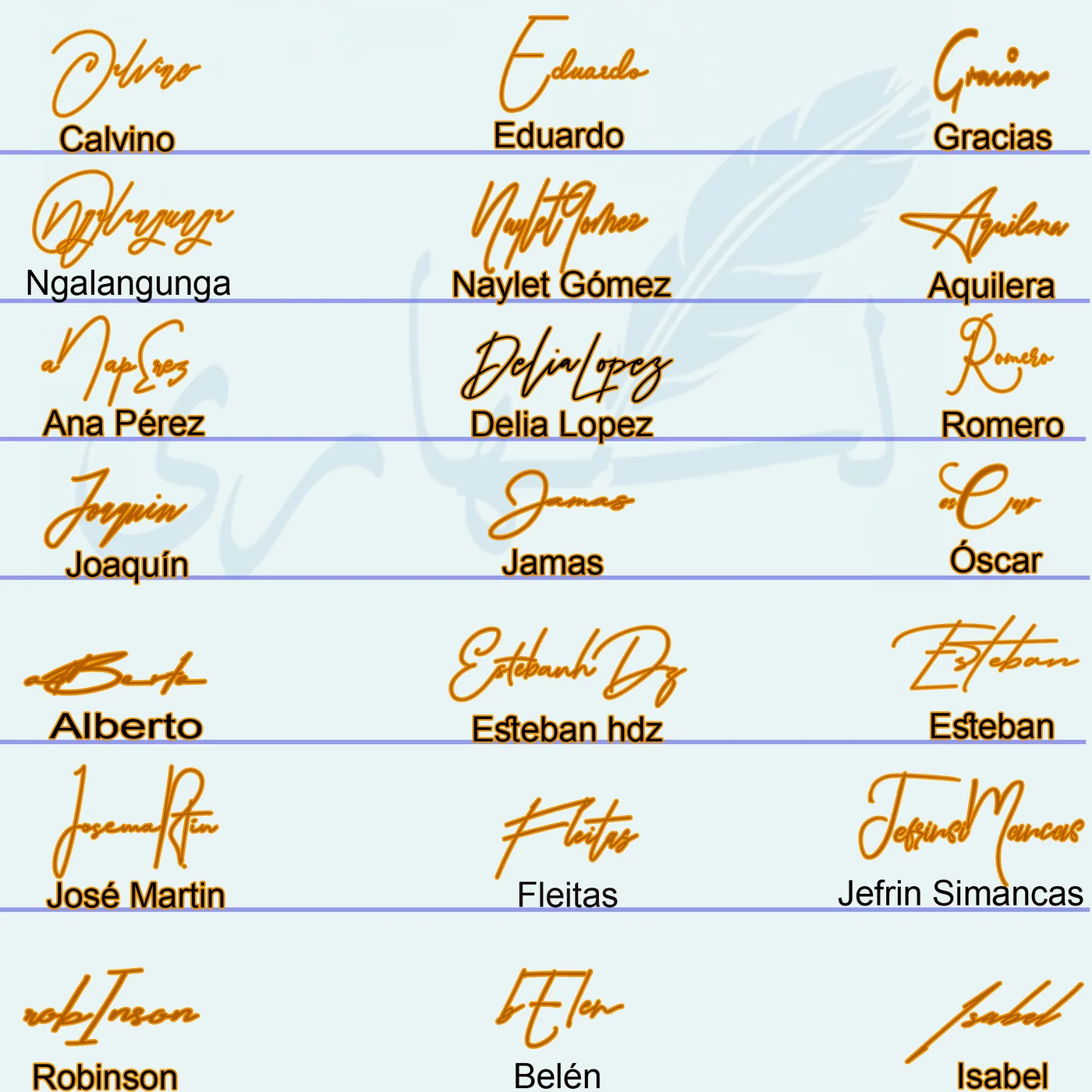
Use the gallery as a construction guide. Instead of copying a finished mark, notice where each signature begins, which letter carries the visual weight, how the middle is compressed, and whether the ending is a clean stop, a tail or an underline.
In this gallery
- Read the examples by structure
- Match a structure to your name
- Recognize natural handwriting
- Practise a repeatable version
How the handwriting signatures are constructed
Large first initials anchor short names
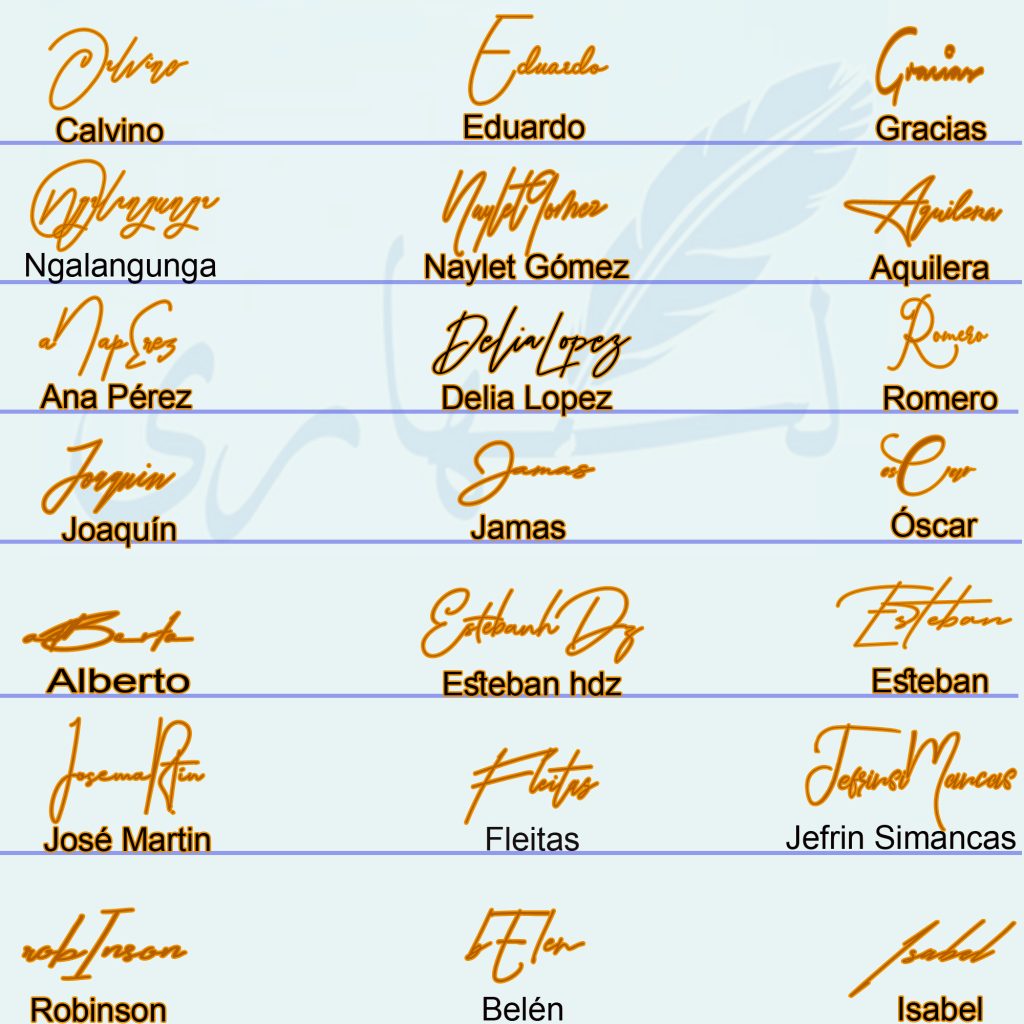
Calvino, Eduardo, Gracias, Romero and Óscar all give the opening capital most of the space. Calvino uses a broad circular C, Eduardo stretches the E vertically, and Romero turns the R into a tall loop before reducing the remaining letters. This approach works because the eye recognizes the first movement even when the smaller letters are written quickly.
Two-word names need one clear hierarchy
Naylet Gómez, Ana Pérez, Delia Lopez, José Martin and Jefrin Simancas show different ways to handle two parts of a name. The strongest designs do not make every capital equally decorative. One letter leads, the second capital marks the surname, and the connecting strokes stay smaller so the signature does not become too wide.
Readable signatures can still be stylized
Eduardo, Joaquín, Estheban and Isabel preserve several visible letters. Their value is not perfect legibility; it is controlled simplification. A readable initial, recognizable rhythm and stable ending can make a signature feel personal without turning the name into an unreadable scribble.
Compact and abstract versions depend on a stable silhouette
Alberto, Fleitas, Robinson and Belén are more compressed. In these examples, the exact internal letters matter less than the overall direction, height and final stroke. An abstract style only works when you can reproduce the same silhouette at normal signing speed.
Choose a handwriting structure for your name
| Your name | Useful structure from the gallery | Why it fits |
|---|---|---|
| Short single name | Large initial plus readable body, like Calvino or Eduardo | There is enough room to keep several letters visible |
| Medium single name | Looped initial with compact connected middle, like Romero or Estheban | The capital stays memorable while the body remains quick |
| Two short names | Two capitals with a smaller connection, like Ana Pérez | Both parts remain identifiable without equal decoration |
| Long two-part name | One dominant initial and compressed surname, like Jefrin Simancas | Reduces width and writing time |
| Very quick personal mark | Compact silhouette, like Fleitas or Robinson | Fewer detailed letters make repetition faster |
For a wider comparison of cursive, initial-based, minimalist and underlined constructions, see the guide to different signature styles. The signature examples for your name also show how name length changes the balance between capitals and smaller strokes.
What makes a signature look naturally handwritten?
- Continuous direction: the exit of one letter prepares the movement of the next instead of stopping at every character.
- Unequal emphasis: one or two capitals are larger while the middle letters are faster and less detailed.
- Controlled variation: repeated versions are similar in structure, even though tiny curves and spacing are not mechanically identical.
- Economical pen lifts: most of the signature is produced in one or two connected movements.
- A purposeful ending: the tail, underline or final stop belongs to the writing motion rather than being added as unrelated decoration.
A handwriting font can help you explore shapes, but it does not automatically produce your personal movement. Type-based previews are most useful as rough inspiration. The final design should be rewritten by hand until the connections and proportions feel natural.
Do not judge a signature only by how it looks once. Judge it by how well its main shape survives five normal-speed repetitions.
Turn one example into a repeatable signature
- Write your name normally five times. Circle the initial and connections that already feel comfortable.
- Select one gallery structure. Choose a large initial, two-capital format, compact silhouette or connected underline.
- Keep only one new feature. Adding several loops and strokes at once makes it difficult to identify what improves the design.
- Sign at realistic size. Practise on a line similar to the space available on forms, cards or documents.
- Compare width, slant and ending. These three features should remain more stable than every individual letter.
- Simplify the unstable part. If a loop or crossing changes each time, shorten it rather than slowing the whole signature down.
Frequently asked questions
Does a handwritten signature need to show every letter?
No. Many effective signatures keep the initial, part of the surname or the overall letter rhythm recognizable while simplifying the middle. The right level of readability depends on your preference and use.
Which example is easiest for a beginner?
A large initial followed by a short connected body is usually easier than a multi-loop abstract mark. The Eduardo, Joaquín and Isabel structures are useful starting directions in this gallery.
Can a long name have a short handwritten signature?
Yes. Use the first initial plus a compact surname, two initials, or one dominant capital followed by a shortened movement. Keep the same core structure each time.
Should I add an underline?
Only when it grows naturally from the last stroke. A separate underline can make the design slower without improving its identity.
How do I know when the design is finished?
It is ready when the main initial, width, slant and ending remain reasonably consistent at normal speed and no decorative detail needs careful drawing.
Single Signature Examples from This Collection
These individual handwritten signature images are included as supporting examples so visitors can compare one name at a time. Each caption preserves the name reference and makes it easier to study initials, loops, finishing strokes and overall signature flow.