Handwritten Name Signature Examples: 21 Designs
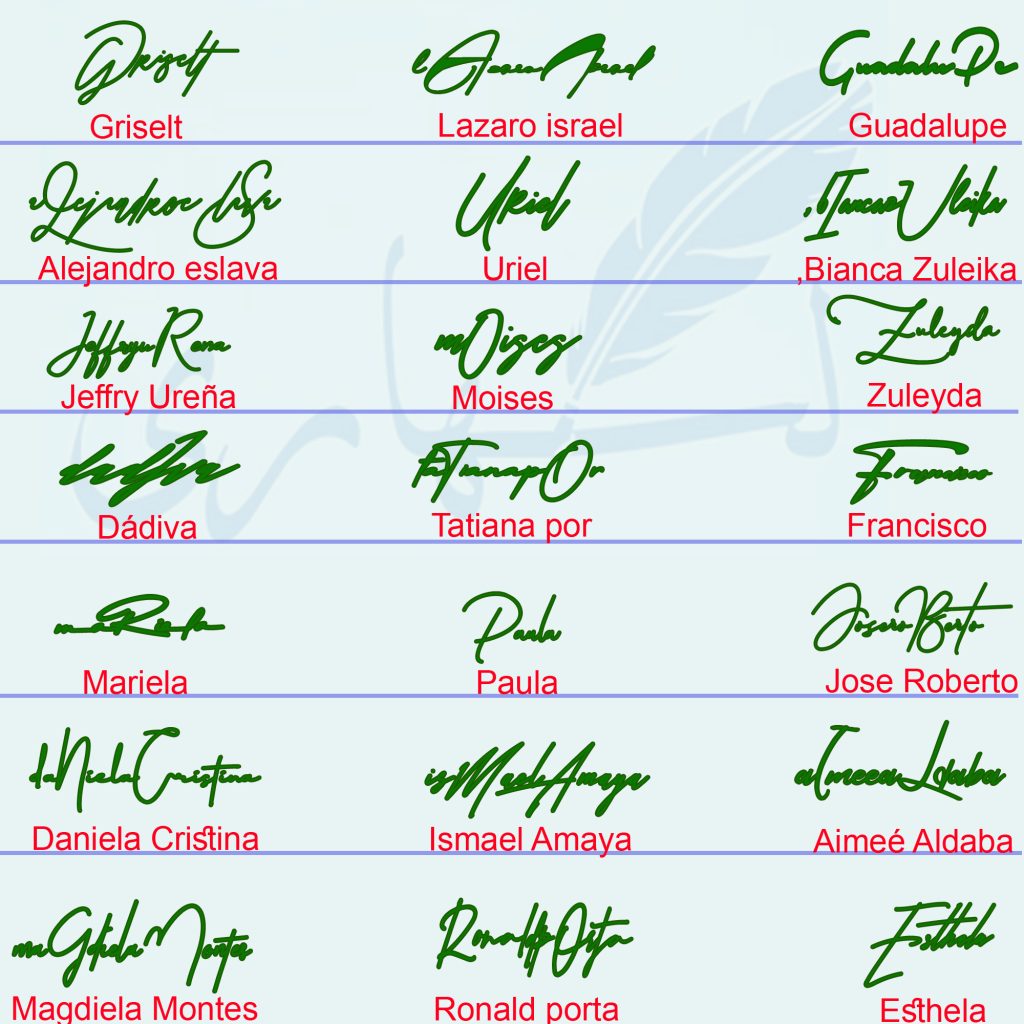
These handwritten name signature examples show how the same basic decisions—name length, number of capitals, readability and finishing movement—produce very different results. The collage includes 21 short, medium and two-word names, making it useful for choosing a structure before you begin practising.
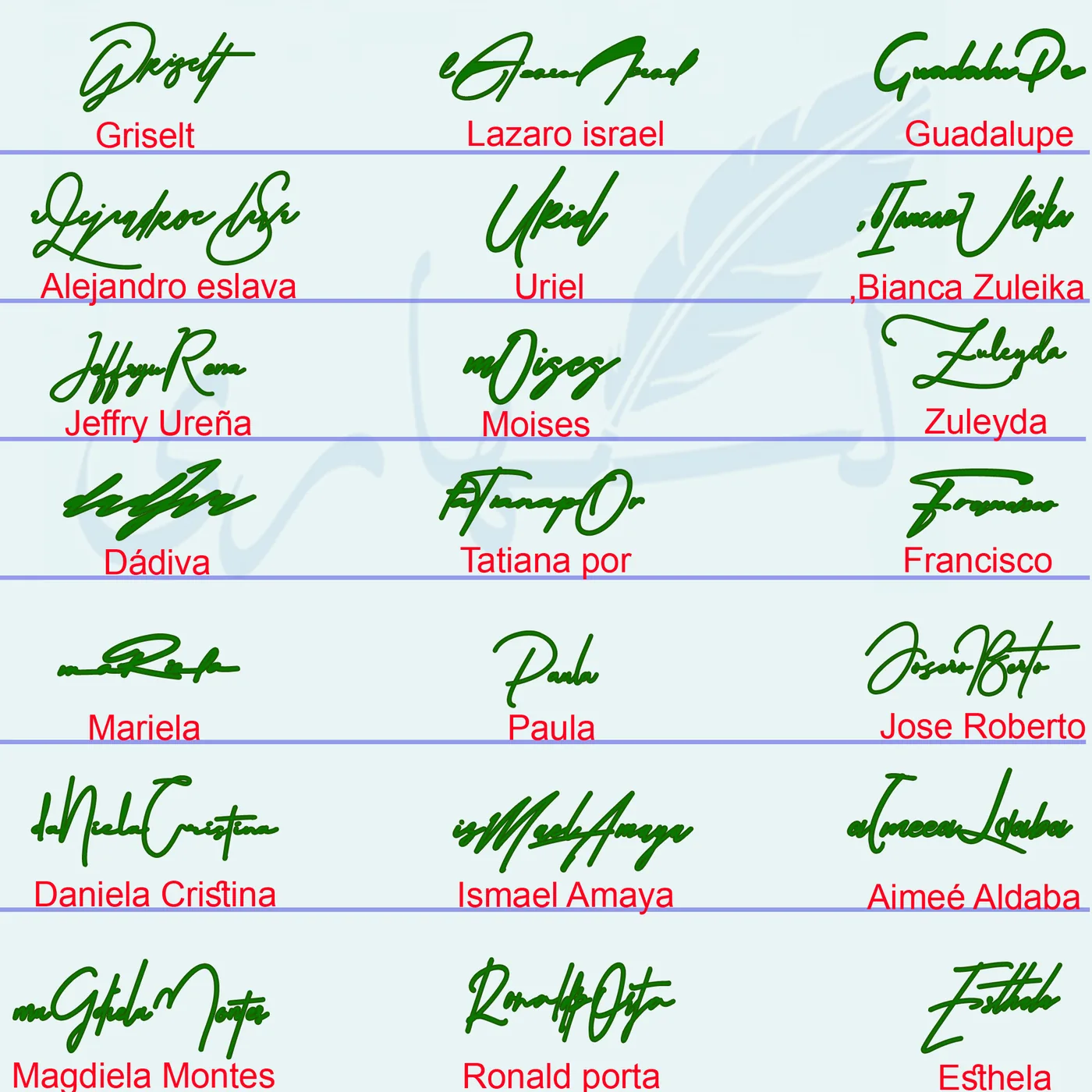
Start by finding a name with a similar pattern to yours, not necessarily the same first letter. A two-word name with two tall capitals creates a different design problem from a short single name, even when both begin with the same letter.
In this gallery
- Compare short and full names
- Study the capital hierarchy
- Choose readability or compression
- Build a design from your name
Name formats represented in the gallery
Short single names can preserve more letters
Uriel, Moises, Zuleyda, Francisco, Mariela, Paula and Esthela have enough space to show a readable capital and several connected letters. Uriel uses a tall, open first movement; Paula keeps a rounded P and visible body; Francisco combines a wide top stroke with a compact middle.
Long single names benefit from compressed middles
Guadalupe and Zuleyda demonstrate how a longer name can retain a recognizable beginning and ending while simplifying the internal letters. The middle should still follow a consistent baseline and direction; compression works best when it looks intentional rather than cramped.
Two-word names need a clear transition
Lazaro Israel, Alejandro Eslava, Jeffry Ureña, Jose Roberto, Daniela Cristina, Ismael Amaya, Aimeé Aldaba, Magdiela Montes and Ronald Porta all contain two name parts. The useful lesson is the transition: some use a second visible capital, while others join the surname into the same horizontal flow.
Very compact marks rely on the opening and ending
Dádiva and Mariela are reduced more heavily than the readable examples. Their identity comes from the shape of the opening stroke, the direction of the body and the final line. This can be efficient, but only after the silhouette remains stable in repeated writing.
How to use capital letters in a name signature
A capital letter is not merely larger; it controls the direction of the signature. In Alejandro Eslava, the first capital creates a long lower sweep before the name continues. Jose Roberto gives both J and R visible roles. Ismael Amaya and Magdiela Montes use two strong capitals but keep the connecting letters much smaller.
- One-word name: make the first capital the only major focal point unless the final letter naturally creates a useful tail.
- Two-word name: decide whether the surname capital should be visible, reduced or absorbed into one connected movement.
- Two tall capitals: vary their height so the signature has hierarchy rather than two competing peaks.
- Repeated round letters: compress the middle loops to prevent the name from becoming too wide.
- Accented names: decide whether the accent is written as part of the natural movement or added consistently afterward.
Choose readability or compression intentionally
| Preferred result | Examples to study | Design choice |
|---|---|---|
| More readable single name | Uriel, Paula, Francisco | Keep the initial and several body letters visible |
| Readable two-word name | Jose Roberto or Daniela Cristina | Show both capitals and simplify only the connecting letters |
| Elegant long-name flow | Alejandro Eslava or Ismael Amaya | Use one dominant sweep and a smaller surname transition |
| Short compact mark | Dádiva or Mariela | Preserve a stable opening and ending while reducing the middle |
| Balanced two-capital design | Aimeé Aldaba or Magdiela Montes | Let one capital lead and the second confirm the name break |
For another gallery organized around different lengths and initials, compare the signature examples for your name. If your goal is a very compact result, the short signature guide focuses on initials and abbreviated structures.
Build a handwritten signature from your own name
- Count the name parts. Decide whether you are signing one name, a full name, initials or an initial plus surname.
- Identify the strongest capital. Choose the letter your hand writes most comfortably and make it the anchor.
- Mark natural connections. Join only the letters that move in the same direction without forcing awkward turns.
- Reduce the middle gradually. Keep the first and last movements recognizable while shortening repeated internal shapes.
- Test a second capital. For two-word names, compare a visible surname capital with a fully connected version.
- Choose one ending. Use a clean stop, short tail or integrated underline and repeat it at normal speed.
The related signature in handwriting examples explain how continuous direction, pen lifts and stable silhouettes make a design feel more natural.
Frequently asked questions
Should my signature include my full name?
It can, but it does not have to for design practice. Full names favor readability, while initials or an initial-plus-surname format reduce length. Follow the requirements of the document or organization where the signature will be used.
What is a good format for two long names?
Use one dominant first initial, a compact first-name body, a smaller surname capital and a shortened surname movement. Avoid decorating both capitals equally.
How readable should a handwritten name signature be?
Keep at least the main initial, name rhythm or surname structure recognizable if readability matters to you. Full letter-by-letter legibility is not required for every style.
Can I change the spelling shape of my name?
You can stylize and compress letterforms, but preserve a structure you understand and can repeat. For formal uses, follow any specific identity or signing requirements that apply.
How do I choose between two designs?
Write each design five times at normal speed. Choose the one with the more stable width, capital shape, slant and ending—not simply the version that looked best once.
Single Signature Examples from This Collection
These individual handwritten signature images are included as supporting examples so visitors can compare one name at a time. Each caption preserves the name reference and makes it easier to study initials, loops, finishing strokes and overall signature flow.