Short Signature for My Name: 19 Arabic Ideas
A short signature for your name should reduce writing time without losing its main identity. This gallery contains 19 compact Arabic signature ideas, showing how right-to-left movement, connected letter groups, dots, vertical strokes and a single finishing line can turn one- or two-part names into repeatable marks.
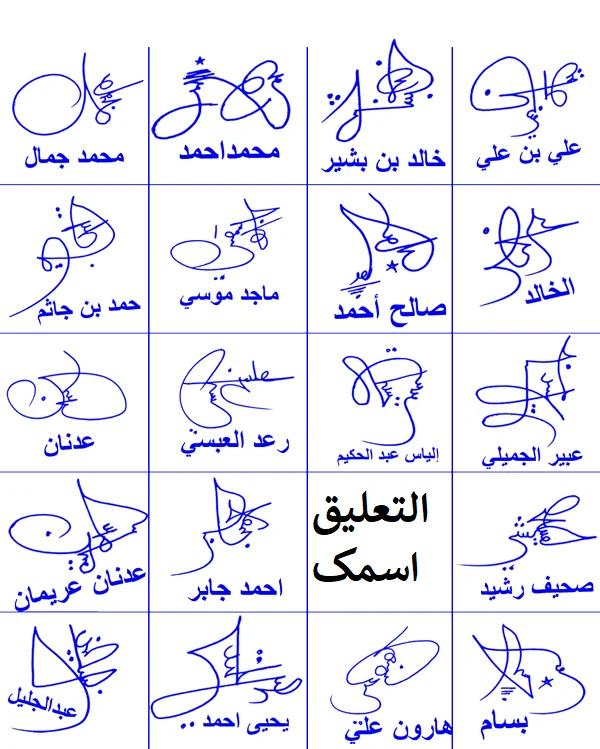
Arabic signatures use a different visual logic from Latin-letter initials. Instead of forcing every name into an English-style monogram, look for a comfortable connected section, one distinctive vertical or loop, and an ending that follows the natural right-to-left motion.
Use the Arabic signature gallery
- Study the compact Arabic structures
- Choose a format for your name
- Shorten without losing clarity
- Practise a repeatable version
How the 19 Arabic signatures stay compact
One-part names can use one dominant loop
Names such as عدنان, الخالد and بسام are reduced to a recognizable main movement with smaller internal details. The design does not need to display every letter at equal size. A broad loop or angled stroke can carry the overall shape while the remaining letters are written quickly.
Two-part names need a clear connection
محمد جمال, محمد أحمد, صالح أحمد, أحمد جابر and يحيى أحمد show how two words can be treated as one composition. The strongest versions do not pause visually between both words; they use a baseline stroke, shared height or finishing tail to keep the signature together.
Longer names benefit from selective emphasis
خالد بن بشير, علي بن علي, حمد بن جاثم, إلياس عبد الحكيم and عبير الجميلي contain more letters and connections. These examples emphasize one tall or curved section while compressing the rest. That hierarchy is more practical than decorating every word.
Dots remain part of the visual rhythm
Dots in Arabic writing can become a useful part of the composition, but they should not be scattered randomly. Keep their approximate placement consistent and avoid adding so many decorative dots that the written name becomes difficult to recognize or repeat.
Choose a short format for your Arabic name
| Name pattern | Practical short structure | Gallery direction |
|---|---|---|
| Short one-word name | One main loop plus a short exit stroke | عدنان, بسام |
| Two short words | Connected baseline with one dominant word | محمد جمال, صالح أحمد |
| Name with “بن” | Emphasize the first name and compress the connector | خالد بن بشير, حمد بن جاثم |
| Long family name | Keep one recognizable letter group and simplify the middle | عبير الجميلي, رعد العبيسي |
| Very compact personal mark | Stable outline with controlled dots and one crossing stroke | الخالد, هارون علي |
How to shorten an Arabic signature without losing control
- Write the full name naturally from right to left. Identify the letter connections that already happen without hesitation.
- Select the core name section. Decide whether the first name, family name or two-part combination needs to remain recognizable.
- Keep one dominant movement. Use a tall stroke, loop or broad baseline as the anchor instead of adding several competing flourishes.
- Compress the middle carefully. Shorten repeated or less important movements, but do not remove every distinguishing feature.
- Preserve useful dots. Simplify their number or placement only when the result remains clear and repeatable.
- Finish with one tail or return stroke. Multiple decorative lines often make a short signature slower than the full name.
- Test at normal size. Write five versions in the space available on a typical form and compare the overall outline.
For a wider explanation of compact, initial-led and underlined constructions, compare different signature styles. The general signature creation guide provides a step-by-step method that can be adapted to either Arabic or Latin-script names.
A short signature is not simply a name written smaller. It is a name reduced to a controlled sequence of movements.
Practise a repeatable Arabic signature
- Maintain direction: keep the same right-to-left flow and similar baseline angle.
- Compare the silhouette: the width, height and position of the main loop should remain stable.
- Watch the dots: place them consistently enough that they look intentional.
- Remove unstable details: shorten any extra hook or crossing that changes in every attempt.
- Practise without tracing: tracing can teach a shape, but free repetition is what makes the movement personal.
Frequently asked questions
Can an Arabic signature be shorter than the full name?
Yes. A signature can emphasize the first name, family name, a connected section or an abstracted overall shape. Choose a format you can reproduce consistently.
Should I use English initials for an Arabic name?
Only if that format suits your real use. An Arabic-script signature can rely on connected letter groups and distinctive strokes rather than forcing the name into Latin initials.
Are dots optional in an Arabic signature?
A stylized signature may simplify details, but dots are part of Arabic letter identity and visual rhythm. Preserve enough structure for the result to remain intentional and recognizable to you.
Which Arabic signature style is easiest to repeat?
A design with one main loop, a compact connected body and one finishing stroke is generally easier than a mark with several separate crossings, stars and decorative lines.
Single Signature Examples from This Collection
These individual handwritten signature images are included as supporting examples so visitors can compare one name at a time. Each caption preserves the name reference and makes it easier to study initials, loops, finishing strokes and overall signature flow.