Cursive Name Signature Ideas: 21 Flowing Designs
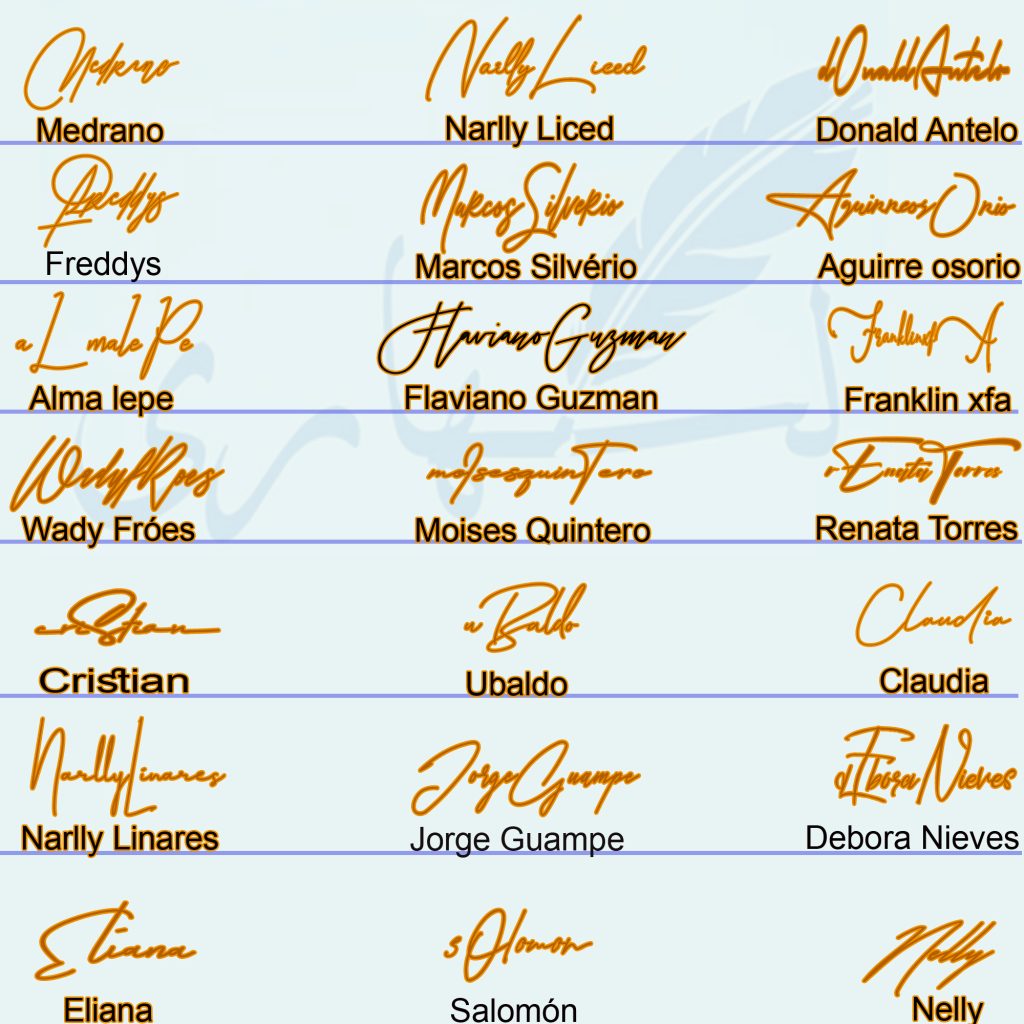
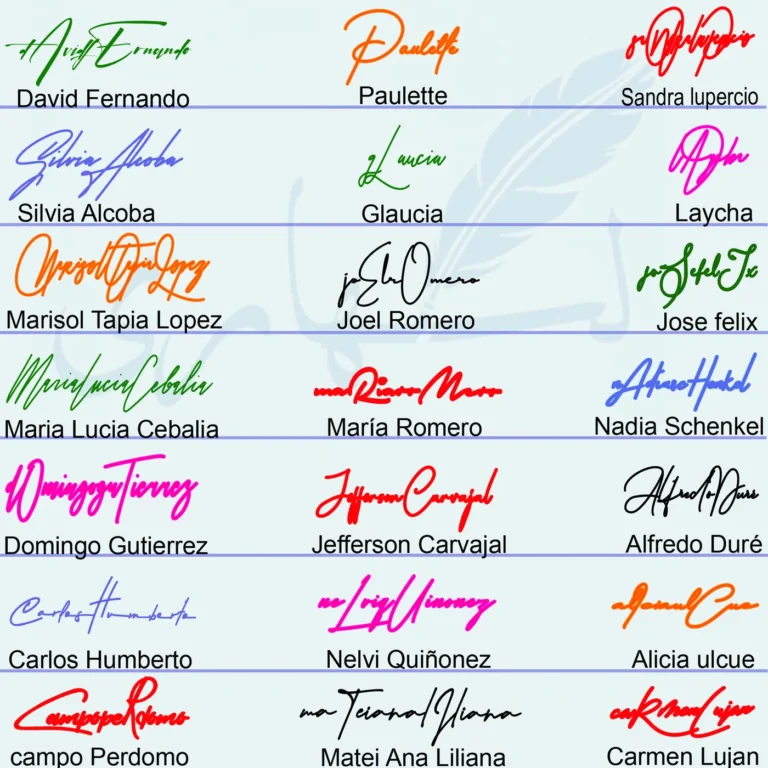
Cursive name signature ideas are most useful when they show how a name can flow, not just how it looks in a decorative font. The 21 examples below compare oversized initials, connected lowercase strokes, two-capital structures and compact endings for short, long and two-word names.
Treat this collage as a design reference rather than a page of signatures to copy exactly. The strongest approach is to borrow one construction idea—such as a large opening capital or a long exit stroke—and rebuild it in your own natural handwriting.
Explore the gallery
- Read the examples by structure
- Match a cursive style to your name
- Judge flow and repeatability
- Build your own cursive version
How the 21 cursive designs are constructed
A large first letter carries short and medium names
Medrano, Freddys, Cristian, Ubaldo, Claudia, Eliana and Nelly all rely on one dominant opening movement. The first capital is larger than the rest of the name, while the middle letters are compressed into a quicker rhythm. This gives the signature a recognizable silhouette without making every letter equally detailed.
Two-word names need a clear visual hierarchy
Narlly Liced, Donald Antelo, Marcos Silvério, Aguirre Osorio, Wady Fróes, Moises Quintero, Renata Torres, Narlly Linares, Jorge Guampe and Debora Nieves show several ways to handle two parts of a name. The better-balanced designs let one capital lead and use the second capital as a smaller checkpoint. When both words compete for the same height and decoration, the result becomes wide and harder to repeat.
Long names work better when the middle is simplified
Flaviano Guzman and Marcos Silvério remain readable because the first and surname capitals are visible while the connecting letters are lighter. A long name rarely needs every internal letter to be carefully drawn. What matters more is a stable opening, a consistent slant and an ending that does not change each time.
Compact names can use an underline or exit stroke
Cristian and Salomón use horizontal movement to give a small word more presence. Renata Torres and Moises Quintero use long finishing strokes to balance a broader name. An underline is most effective when it grows naturally from the last letter instead of being added as a separate decoration.
Match a cursive signature style to your name
| Name pattern | Useful construction | Examples in the collage |
|---|---|---|
| Short single name | One large initial, compact connected body and a clean ending | Claudia, Eliana, Nelly, Ubaldo |
| Medium single name | Tall opening loop with a compressed middle | Medrano, Freddys, Cristian, Salomón |
| Two short words | Two visible capitals with a smaller connection | Renata Torres, Narlly Liced |
| Long two-word name | One dominant capital, lighter surname body and controlled width | Marcos Silvério, Flaviano Guzman |
| Name with strong final letters | Use the last letter to form a tail or underline | Moises Quintero, Jorge Guampe |
For a broader comparison that includes initials-only, minimalist, angular and underlined options, see different signature styles. The guide to choosing a signature style for your name focuses more directly on name length and visual balance.
How to judge a good cursive signature
- Natural entry: the opening stroke should be comfortable at normal writing speed, not a shape that has to be drawn slowly.
- Useful connections: connected letters should reduce pen lifts rather than create tangled crossings.
- Stable proportions: the dominant capital, total width and final stroke should remain similar across repetitions.
- Selective readability: a visible initial and one or two recognizable letter groups are often enough; complete legibility is optional.
- Controlled finish: a tail or underline should stop deliberately instead of drifting far beyond the name.
A cursive signature is successful when its main shape survives normal-speed writing. A beautiful version that only works slowly is still a draft.
Build your own cursive name signature
- Write your name normally. Notice which letters already connect without effort.
- Choose the name format. Test your full name, first name only, initials, and first initial plus surname before adding decoration.
- Enlarge one capital. Use the first or surname initial as the visual anchor rather than enlarging every capital.
- Compress the middle. Keep the internal letters smaller and quicker while preserving a steady baseline.
- Add one finishing feature. Try a short underline, upward tail or return stroke, but not all three at once.
- Sign five times at realistic size. Compare width, slant and ending; simplify any part that changes too much.
- Create a clean digital copy only after the handwriting works. A typed preview can inspire you, but it should not replace a repeatable hand movement.
Frequently asked questions
Should a cursive signature include my full name?
Not necessarily. A first initial plus surname, a shortened full name or a single-name design can be easier to repeat. Test several formats before choosing one.
Do all letters need to be readable?
No. Many cursive signatures keep the initial and overall rhythm recognizable while simplifying the middle. The important part is that the result feels intentional and repeatable.
Is an underline necessary?
No. An underline can help a short or narrow signature feel balanced, but it should be removed if it slows the writing or looks disconnected from the final letter.
Can I use a cursive font as my signature?
A font can help you compare shapes, but a personal handwritten signature should be adapted to your own movement. Practise the idea by hand and simplify it until it feels natural.
Single Signature Examples from This Collection
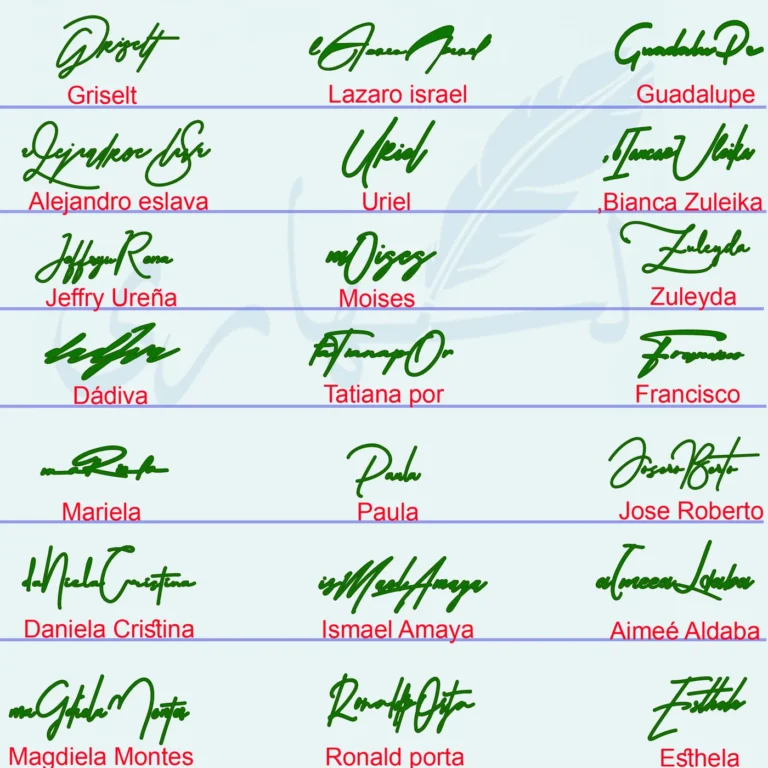
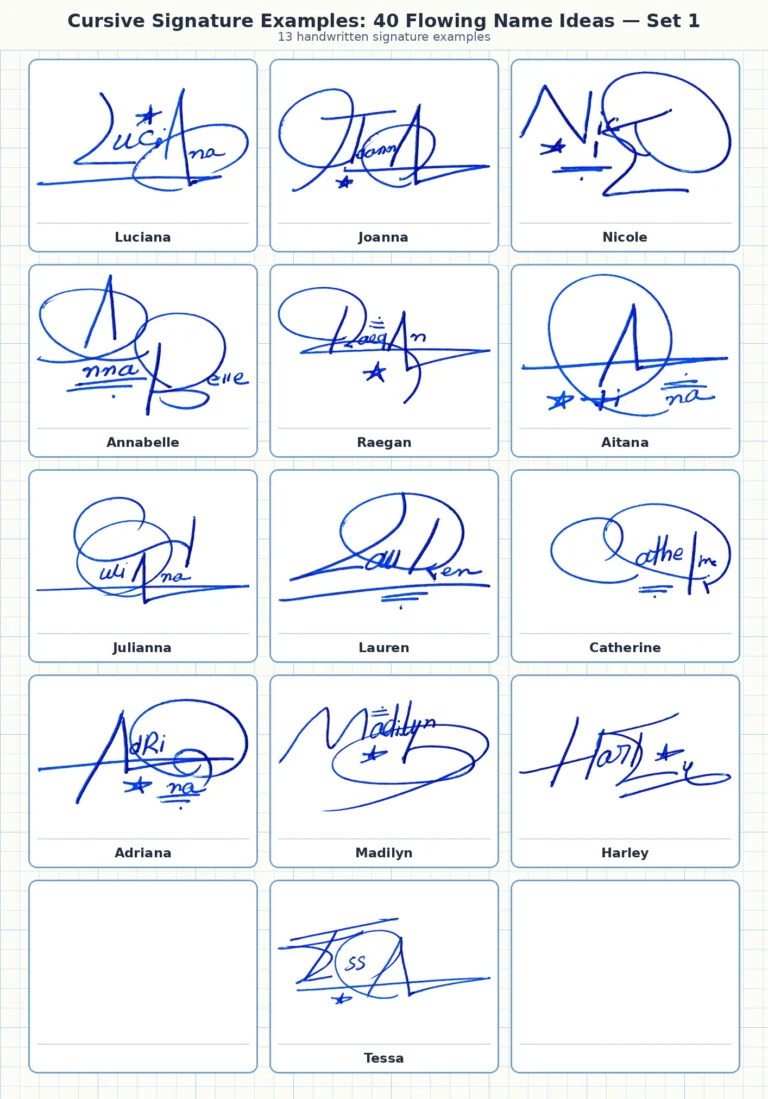
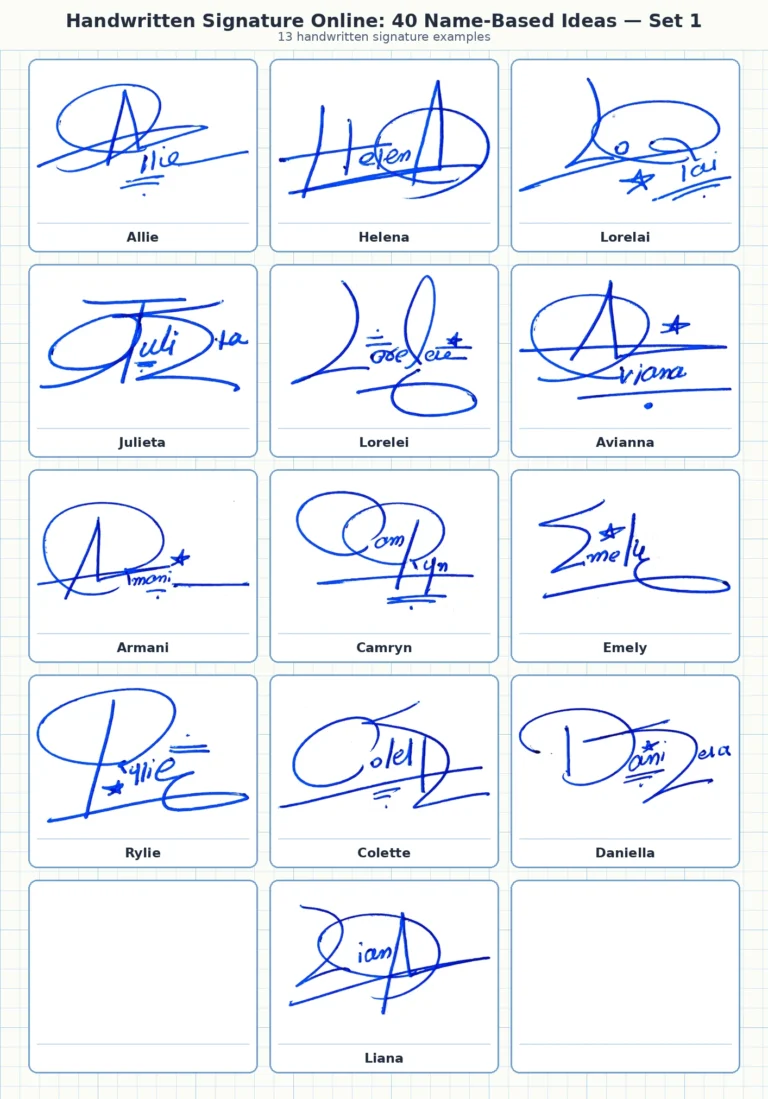
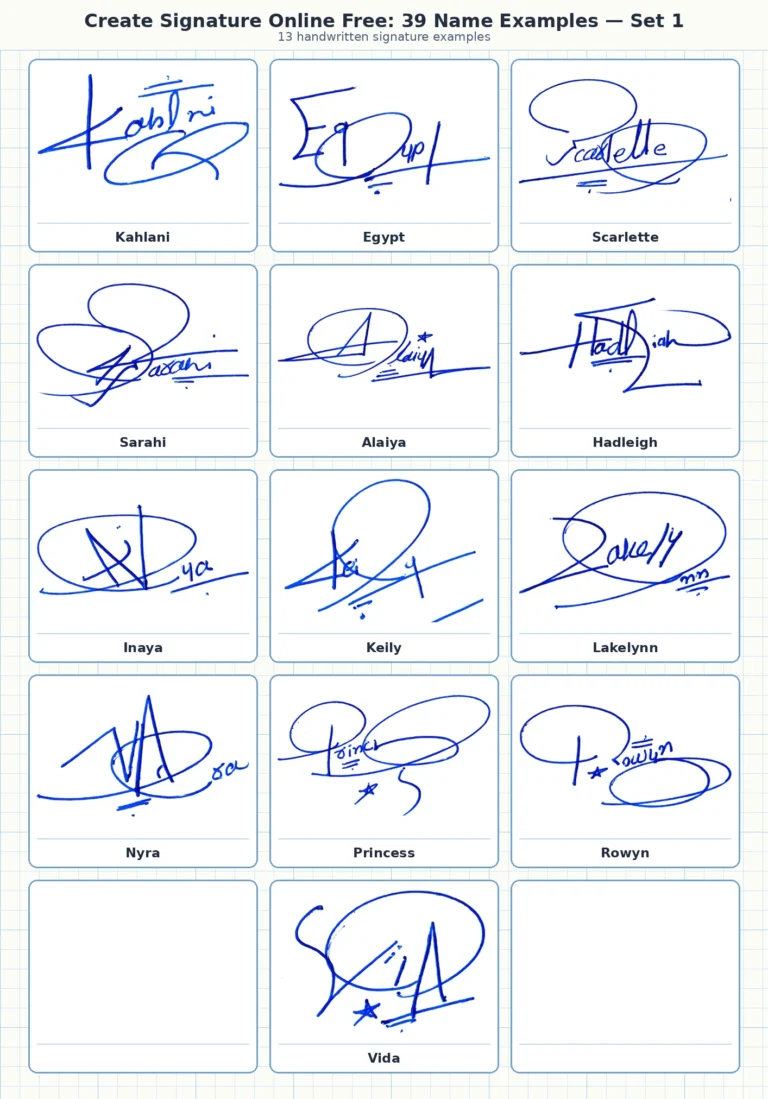
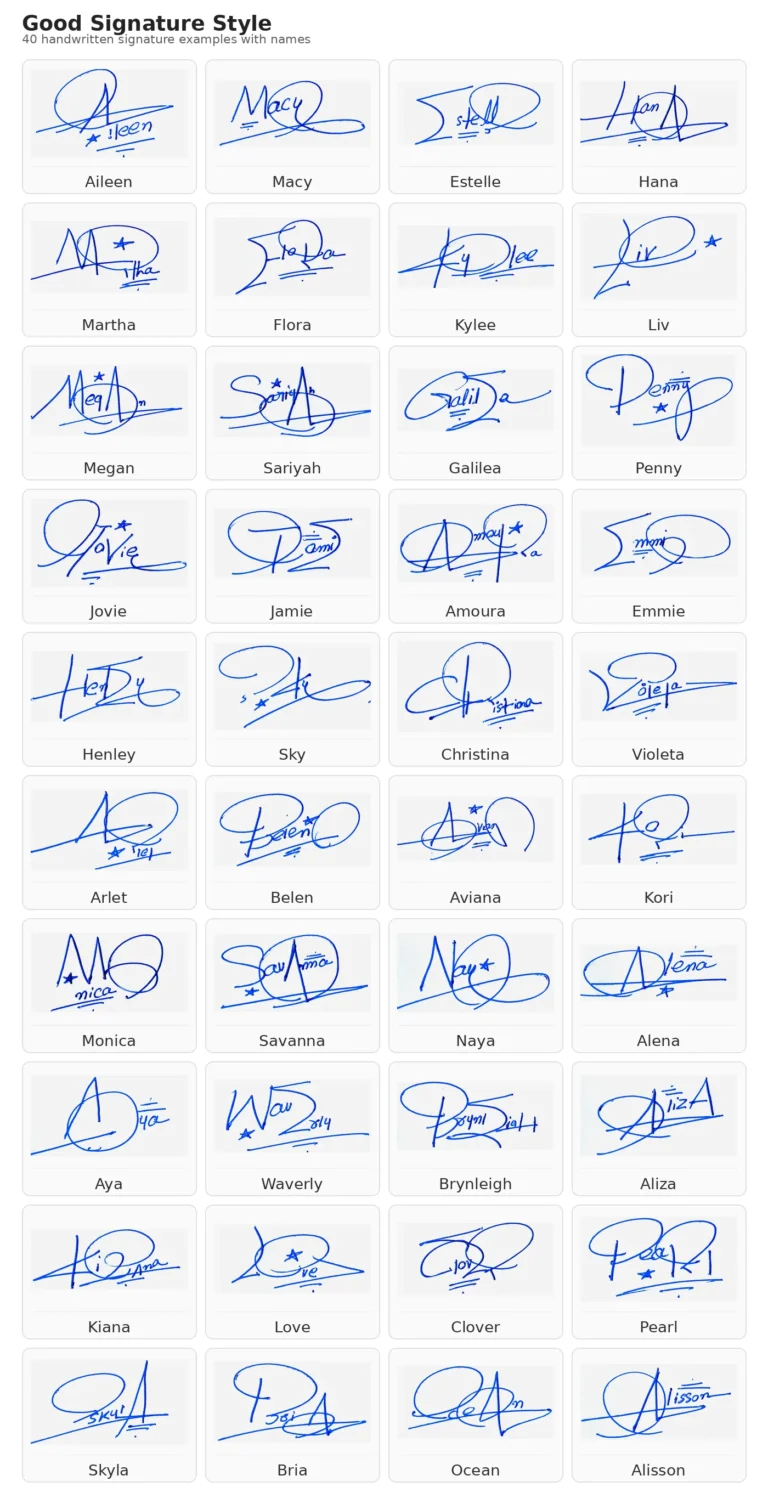
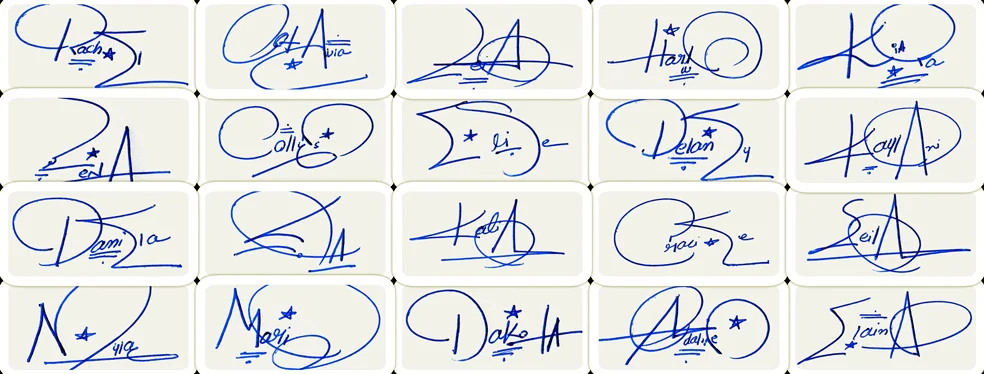
These individual handwritten signature images are included as supporting examples so visitors can compare one name at a time. Each caption preserves the name reference and makes it easier to study initials, loops, finishing strokes and overall signature flow.